Tuesday, 4 November 2008

Develop conference 2009 in Brighton

Grab your diary and pencil it in - the 2009 Develop Conference and Expo will take place from July 14th to 16th in Brighton. Back for its fourth year, the event will once again bring together the cream of the international development community for three days of learning, inspiration, networking and fun. In addition to all of the talks, panels and roundtables you'd expect, next year's event will place increased emphasis on the first day's themed proceedings.

"The Develop Conference in Brighton is firmly established as the leading UK game developers conference," said Andy Lane, director of conference organiser Tandem Events. "It brings together every branch of the development community who come to learn as well as network, and our high quality conference programme is one of the things that sets Develop apart".

"For 2009 we're adding a new dimension to the event by focusing the first day on the latest innovations that are taking place in social, casual, handheld and online - the next frontier - of game development. Once again, the main programme will include more big name speakers from around the world - the Develop Conference has a global reach - attracting speakers from America, Europe and Asia as well as the very best home grown talent," he said.

"And on top of all the brainy stuff, there are the networking opportunities, parties, drinks and awards and, dare I say it, the chance to have a bit of fun by the sea in sunny Brighton."

Keep your eyes peeled on the official Develop Conference website for more information.

Saturday, 1 November 2008

Google Earth launches on iPhone

Google just released an iPhone version of its popular Google Earth desktop mapping application. There's been a wide range of interesting iPhone applications lately, but few have been as impressive, or as relevant to mobile navigation, as Google Earth on the iPhone. Google has taken the basics of the Google Earth interface and brought them to the iPhone.

Besides bringing the basic Google Earth features to the phone, the iPhone app also displays links to Wikipedia articles and photos from Panoramio. Because Google integrated a browser into the app, you can seamlessly jump back and forth between the app and the web content. Of course, the app also makes use of the iPhone's GPS, though the lack of street names on the satellite images still gives the standard Google Maps application an edge over Google Earth for navigation.

A drawback would be that for some reason Google thought that it would be a good idea for the app to zoom in from space to your last location every time you start the app. Also, while Google Earth on the desktop allows you to add various layers with information, the iPhone app doesn't even have the ability to show a layer with street names (probably due to the limits of the phone's processing power and memory). Finally, Google Earth uses the iPhone's accelerometer to tilt the screen. As long as you are sitting at your desk, this works great, but once you hand your phone to somebody else, the screen will inevitably tilt and move the focus, which can be quite annoying.

All in all, despite the minor gripes above it is great to see Google Earth on the iPhone and hopefully Google will see sense to expand its 3D navigation capabilities to suit the mobile device rather than see it as another desktop-to-iPhone port.

Sony patents Ultrasonic interaction controller

Sony Computer Entertainment America has filed a new U.S. patent describing a controller that employs "hybrid video capture and ultrasonic tracking" technology. The patent states that the system senses the movement of "one or more" controllers in a 3D space.

From the patent's abstract: "The captured video information is used to identify a horizontal and vertical position for each controller within a capture area. The ultrasonic tracking system analyzes sound communications to determine the distances between the game system and each controller and to determine the distances among the controllers. The distances are then analyzed by the game interface to calculate the depths within the capture area for each controller."

The patent was filed on June 24 this year. The breakapart controller displayed in images accompanying the filings could be assembled as a large sound- and space-sensing scepter. If such a product ever sees the light of day, it could look considerably different than the pictures exhibit, as SCEA stated "certain changes and modifications may be practiced" within the parameters of the patent.

Saturday, 25 October 2008

Bournemouth University Open days

I spent this morning and afternoon at Bournemouth University (where I work as a lecturer) as part of one of their Open Days, answering questions from prospective questions and, perhaps more importantly, demoing 3D modelling and animation work for the upcoming Computer Games Technology BSc degree that the University is recruiting for (to start in Sep 2009).

The next Open Day that we have is on November the 15th, if you're interested in the Computer Games Technology course, or indeed any other course the University runs you're more than welcome to attend. You'll be able to attend talks by academic staff on the subjects of your choice and have an opportunity to ask questions plus also be shown around the campus and ask our student ambassadors questions. Finally you can also enjoy a bus tour around the Bournemouth area including a view of our accommodation, Student Union locations, beaches and the town centre.

http://www.bournemouth.ac.uk

Friday, 24 October 2008

Autodesk (owner of 3DS Max and Maya) acquires Softimage XSI

Maya, 3ds Max and MotionBuilder owner Autodesk is to acquire its rival Softimage for $35m. The surprise deal, announced last night, puts all the leading 3D graphics applications used by the games industry (Softimage is responsible for the XSI and FaceRobot apps, amongst others) under one owner following three years of active acquisitions on Autodesk's part.

Autodesk bought Maya creator Alias in 2006, and has kept development of the application going ever since. Last year it bought high-end renderer Mudbox creator Skymatter, and in early 2008 acquired AI specialist Kynogon. Founded in 1986 by Daniel Langlois, Softimage's technology is already in use a number of entertainment graphics and special effects firms, including Digital Domain, Ubisoft, Sega, Capcom, and The Mill. The company itself has had a chequered ownership history, at one point being owned by Microsoft before being bought by Avid and integrated into its large family of digital editing and media tools. Avid will be paid around $35m for the acquisition.

Although the two businesses will now be combined, Autodesk said that it will "continue developing and selling Softimage’s core product line, while integrating certain Softimage technology into future versions of Autodesk solutions and products".

Thursday, 23 October 2008

Tiga calls for UK to improve game development-related education

In the latest issue of its policy magazine Download, UK independent developer association Tiga has called on UK authorities to improve the standards of higher education in order to increase the number of talented students ideal for a job in games development. Tiga outlined a number of recommendations it was putting to the Government;

• introduce a pilot programme whereby the tuition fees for students studying mathematics and computer science are reduced to give students a greater incentive to study these subjects;
• reverse the cuts that have taken place in computer science course funding; and
• aim over time to increase higher education funding from the current 1.1% of Gross Domestic Product (GDP) in order to enhance the quality of UK universities (the USA and China spend 2.9% and 1.3% respectively of GDP on higher education).

Tiga also called for the establishment of a Tiga managed Games Education Fund which could, for example:
• promote industrial secondments by funding the placement of lecturers in games businesses;
• fund research fellowships by enabling lecturers to concentrate on research activities rather than administrative and teaching responsibilities for between a term and an academic year;
• enable more games businesses to engage in education outreach and knowledge transfer with universities; and
• award individual lecturers and their universities for excellence in teaching, judged by their commitment to teaching, building industry-university links and other actions which ensure the output of first class quality graduates for the games industry.

"If the UK video games industry is to maintain its competitive edge then we must address the skills shortages hampering the industry. We need to improve standards in mathematics and the sciences in schools in order to increase the potential pool of graduates in these disciplines. Stronger financial incentives to attract the best graduates to teach in schools are part of the solution," said Richard Wilson, CEO of Tiga.

"In higher education, tuition fees for mathematics and computer science students should be reduced in order to increase the supply of graduates in these areas. Additionally, our universities must be adequately funded. Cuts in computer science courses should be reversed. Students need up to date equipment and software".

"Employers have a vital part to play in improving skills in the games industry. The Government should aim to reduce corporation tax on businesses to leave them with more money available for investment, including on training. We need to strengthen industry-university links in the games industry. The establishment of a Tiga managed Games-Education Fund would achieve this objective. Deploying the Fund to promote industrial secondments, research fellowships, education outreach and knowledge transfer programmes, and excellence in teaching would not only strengthen links between developers and academia. Ultimately it would help to enhance the competitiveness of the UK games development sector."

Saturday, 18 October 2008

XNA 3.0 to be released, support for mobile device and Visual Studio 2008

Microsoft has revealed that XNA Game Studio 3.0 will be released on October 30th. The latest version chiefly adds Microsoft's Zune music player as a development target, as well as supporting the new Xbox Live Community Games initiative - itself planned to launch as part of the New Xbox Experience hitting Xbox 360s worldwide on November 19th.

More importantly for most, it's the first release of XNA to properly support Visual Studio 2008. In preparation for the Community Games launch, the XNA team has also penned the first draft of what it calls the Community Games Best Practices - a set of guidelines geared towards providing the best experience for players and converting them into buyers.

Skillset's London Games Festival

The deadline is nearing for interested attendees to register for this month's Skillsweek. The London Games Festival event is a week-long Skillset-backed set of workshops and seminars to look at talent and training. The event runs from October 27th to 31st, and hopes are high that over 250 will attend, repeating Skillsweek's success after its debut last year.

Kate O’Connor, executive director at Skillset, commented: "Game development has one of, if not the, most diverse skills requirements of all modern media. From mathematicians and physicists at one end of the spectrum to, actors and architects at the other, the UK gaming industry must be able to tap into these skills to maintain its position as one of the world leaders. Successful and popular forums like Skillsweek are exactly what the industry needs to help confront the skills challenge. It provides the perfect platform from which experts can debate the issues and exchange views on best practice."

According to Skillset, this year’s programme includes:
- The return of last year’s Mod Workshop. Everyone will be taught the basics of level design with Unreal Engine 3, from basic geometry to lighting and implementing AI.
- Scarce Talent Seminars: looking at how to cross the gap from mod-maker or bedroom programmer to professional developer, how to get into audio for games, research and development jobs in the games industry. Tuesday will delve into topics often neglected by games industry events
- A Game Design Workshop: the best way to focus on game design is with a paper prototype. In this workshop, you'll learn how to produce a prototype board game from scratch
- The Coding Dojo Workshop: learn Agile Development Skills and the basics of flash as well as pair programming and other agile techniques
- The C Word: a whole day of high level panels and talks on the skills shared between VFX, animation and game development

Sunday, 12 October 2008

Softimage XSI case study on Tecmo's Ninja Gaiden

Following from last month's post of me praising the making-of article on the official Softimage XSI website where Metal Gear Solid 4 was shown throughout its various stages of creation, the nice people at Softimage have done another one of those excellent features, this time on the Ninja Gaiden 2 game title.

Behind the development of this game is Team Ninja, a game production group at TECMO, LTD. The team said that their objective for the new Ninja Gaiden 2 was to develop a game that was as enjoyable to look at as it was to play. In particular, their mission was to fully utilize the processing capabilities of the next-generation Xbox 360 to take real-time image display to the next level.

To create expressive animated characters the creative team started working with real-time shaders to add details that would improve the game resolution required for a next-generation console. But the main issue they faced was how to raise the quality of the facial animation that would accompany this added detail. It was at this time that one of the directors of Ninja Gaiden 2, Hiroaki Matsui, took a look at SOFTIMAGEFACE ROBOT. The team felt that Face Robot provided the level of accuracy required for facial capture operations. The fact that it was designed with an export function for game run-time was another major reason why they decided to adopt Face Robot...

Read more about this here, while this article is not as thorough as the previously mentioned Metal Gear one it is still well worth anyone with a research or practical interest in 3D games modelling and animation.

Wednesday, 8 October 2008

UnrealScript Studio now available for commercial license

Pixel Mine's tool brings Visual Studio look and functionality to UnrealScript coding by recently making their UnrealScript Studio product available for licensing for commercial game development.

UnrealScript Studio, which recently won the second place in the Tools category of Epic's Make Something Unreal competition, applies many of the features available in Microsoft's Visual Studio to UnrealScript editing, including a comprehensive source-level debugger with breakpoints, stepping and user watches, IntelliSense code completion, Class and other views and code snippets.

The tool builds on Pixel Mine's experience with UE3 - it developed the PC versions of BlackSite: Area 51 and Turok - to provide advanced UnrealScript-specific features, such as mixed-mode simultaneous debugging of C and UnrealScript sources.

While the company will be selling the tool for commercial development, it has also pledged to provide a free version for mod makers and educational institutions built on Microsoft's free Visual Studio 2008 Shell. "We built UnrealScript Studio as a language service for Microsoft Visual Studio 2005 and 2008," said Sam Harwell, project lead on UnrealScript Studio. "This provides a familiar interface that effectively eliminates the time it takes to become proficient with the editor's abilities. It includes both an advanced text editor with IntelliSense and a source-level debugger for UnrealScript 3 that are fully integrated into Visual Studio."

As a big advocate of both UnrealEd and UnrealScript for serious research purposes this is a major development IMO. Check out the company's site at http://www.pixelminegames.com/.

Sunday, 5 October 2008

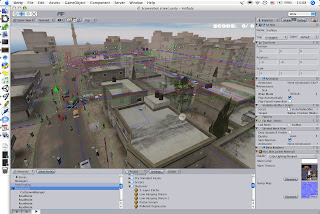
Unity game engine

While game engines like id Tech 5 and Unreal Engine 3 are undoubtedly cutting edge these days and used both for unofficial mods and also for big-money licensing, there's a number of smaller ones that have been making waves recently, particularly noted for their incredible drag-and-drop simplicity and none more so than Unity.

Originally launched as a Mac-based integrated creation tool and game engine for games that worked with a browser-based plug-in, it sat firmly in the same space as technologies such as Director and other Flash-based tools. Coming from a tiny upstart company (Danish outfit Unity Technologies), it was vital Unity worked as simply as possible, at least for gamers. The 3MB plug-in worked with all browsers and, crucially, didn’t require you to reload your webpage, much less restart your browser or enter any registration details.
Additional streaming functionality allowed for the further reduction of load times; something given away by the overall high quality of the graphics. The final key was the pricing: a $200 indie licence per seat for companies with turnover of less than $100,000; a $1,600 pro licence; or the most expensive $2,000 licence, which also includes an integrated version control server.

All told, then, it’s no surprise that year on year Unity has been growing from a secret success story into an ever more public one. Unity is currently being used to create three game portals, five virtual worlds and two MMOGs (Cartoon Network’s FusionFall and an as yet unannounced casual game from Age Of Conan publisher Funcom), while there are also several venture capital-funded projects making use of the technology, not to mention the thousands of licences sold to everyone from bedroom coders to established game studios.

There are other business implications from the model too. The 20-strong company, which splits development duties between studios in Denmark and Lithuania, plus a sales office in San Francisco, has only one full-time support person. It’s something that’s forced it to focus on ensuring the stability of releases, as well as nurturing a strong community.
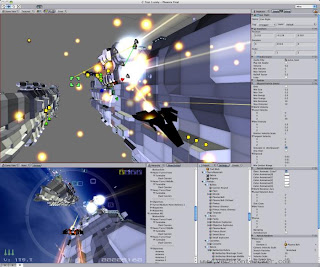
What makes Unity particularly emblematic of today’s gaming culture, however, is the way it has moved from its web-player roots. First up was the ability for developers to create standalone PC and Mac games. Nothing too difficult there, although neat crossplatform features such as optimized graphics pipelines for DirectX 9 and OpenGL helped. Meanwhile, June saw the announcement of the company’s official status as a middleware provider for Wii, while there’s a current internal push to complete support for iPhone.

Of course, iPhone provides the clearest path for casual web developers to get their games on another relatively open platform, but studios are also using Unity to develop Wii titles. Finally, the company expects to add support for other consoles. Currently a Mac-only platform the platform is set to embrace PCs and Windows within the next year or two (at least according to its creators, who, while non-commital on the subject, have gone on record to say how beneficial for the firm a move like that would be).

Check out this very promising engine at http://unity3d.com/

Saturday, 4 October 2008

New Grand Theft Auto game embraces non-photorealism

Some details have been released about the forthcoming Grand Theft Auto game on the kid-friendly DS console. It's going to be isometric, not 3D or top-down, like other GTA games, and more importantly, it's going to be cel-shaded.

New gameplay features seen in GTA IV remain, like the mobile phone, and the GPS directions system which saves you bringing up the map every ten seconds while driving. There's also a different system for your "wanted" rating. Instead of it dissipating if you hide, you're going to have to "disable police cars in any way possible". Aiming will involve the D-pad, but there's also a autotarget. Weapons include the everpresent flamethrower and a chaingun. Finally, there'll be "tasteful" minigames and the ability to upload stats via WiFi to the internet.

I'm looking forward to seeing this as someone with a strong research interest in cel-shaded graphics. It's always encouraging to see AAA titles such as the new Prince Of Persia (featured in an older post) and now this one embracing expressive, non-photorealistic rendering as it shows the commercial potential / dynamic the technology has.

Friday, 3 October 2008

UK Video Game Archive coming to National Media Museum

Academics at Nottingham Trent University are partnering with the Bradford, UK National Media Museum to launch the country's first National Videogame Archive, to preserve the history of the medium and recognize the significant contributions made by videogames to the diversity of popular culture across the globe.

The Archive will not only collect consoles and cartridges, but a broad range of items from across the industry, documenting games as a cultural phenomenon with ad campaigns, magazine reviews, and artwork. It will be housed and cared for at the museum and built and researched in collaboration with the University's Centre for Contemporary Play.

"We don’t just want to create a virtual museum full of code or screenshots that you could see online," says the Centre's Dr. James Newman. "The archive will really get to grips with what is a very creative, social and productive culture." The film industry was late to start building such a trove, says the University, meaning that "countless pieces of historically significant material have been lost forever."

The aim here is to start creating a historical preservation resource early. Paul Goodman, Head of Collections & Knowledge at the National Media Museum, says there will be challenges in exactly how to present the archive. "We must balance the necessary conservation requirements of these materials, with the need to allow the public to understand and interact with them both now and in the future, which is really the cornerstone of what we are trying to do," he says.

The National Videogame Archive will launch at this year’s GameCity 3 festival in Nottingham, for which Nottingham Trent University is the lead partner. Says Newman, "The National Videogame Archive is an important resource for preserving elements of our national cultural heritage.It will not only be a vital academic resource to support growing disciplines in videogame studies but will also be something that the general public can fully engage with."

Wednesday, 24 September 2008

Adobe Photoshop CS4 to feature nVidia acceleration

The latest version of Adobe's Creative Suite will support hardware acceleration with Nvidia GPUs, it has been announced. Photoshop CS4 will utilise any present GeForce or Quadro GPUs in order to speed-up intensive operations such as HDR tone mapping, colour conversion, 3D movement and brush resizing, while also enabling real-time rotation and zooming of images.

Creative Suite stablemates After Effects and Premiere Pro will also benefit from the extra horsepower to quicken HD video editing and effect generation. “A critical element of CS4 was to capture the enormous power of the GPU,” said John Loiacono, senior vice president of Creative Solutions at Adobe.

“The difference is astounding. Performance is important to creative professionals and with the Nvidia GPU, they are assured to be able to interact with images and videos in a much faster, smoother, more engaging way.”

Dan Vivoli, executive vice president of marketing for Nvidia, added: “The GPU being a central ingredient of Adobe Creative Suite 4 is a monumental milestone in the computer industry. Adobe is the recognised leader in revolutionary content tools and this marks the beginning of the GPU accelerated creative revolution. We are honored to have been able to work so closely with the talented engineers at Adobe to help them take their world renowned suite to the next level.”

Tuesday, 23 September 2008

Two-year project for a revolutionary MMO Technology Suite

Nottingham-based Monumental Games has won almost £300,000 of funding from the Technology Strategy Board as part of a project to “revolutionize the Monumental Technology Suite”. The £700,000 project, which will focus on making the massively-multiplayer engine accessible to all and providing a browser-compatible development route, kicks off this month with the aim of commercializing the results within two years. The Monumental Technology Suite currently has over 40 licensees worldwide.

“This is the first year that the Technology Strategy Board has invited applications from the creative industries, and it is encouraging to see recognition for the contribution made by such industries to the UK economy,” said project chairman and Monumental CTO Rocco Loscalzo. “This award for Collaborative Research and Development has enabled us to kick-start a commercially viable but inherently high-risk project, and we can’t wait to get going with our partners,” he added.

Monumental Games will lead the project, partnered by Staffordshire University, Media and Game Technologies, PlayGen and Digital Native Academy. In early September developer Monumental announced that it had seen its staff headcount almost double over the last six months as the firm ramped up development on its flagship MMO title Football Superstars (pictured) and began work on two as-yet-undisclosed projects.

Friday, 19 September 2008

The death of graphics APIs such as OpenGL and DirectX?

According to a very recent interview Tim Sweeney, co-founder of Epic Games and the brains behind every iteration of the widely licensed Unreal series of 3D game engines, claimed that we are soon to see the demise of very popular graphics APIs such as DirectX and even the venerable OpenGL.

At NVIDIA's recent NVISION conference, Sweeney, during a wide-ranging conversation predicted the impending fall of the fixed-function GPU, a fall that he maintains will also sound the death knell for graphics APIs like Microsoft's DirectX and the SGI-authored OpenGL. Game engine writers will, Sweeney explains, be faced with a C compiler, a blank text editor, and a stifling array of possibilities for bending a new generation of general-purpose, data-parallel hardware toward the task of putting pixels on a screen...

All this because "CPU's become so fast and powerful that 3D hardware will be only marginally beneficial for rendering, relative to the limits of the human visual system, therefore 3D chips will likely be deemed a waste of silicon (and more expensive bus plumbing), so the world will transition back to software-driven rendering. And, at this point, there will be a new renaissance in non-traditional architectures such as voxel rendering and REYES-style microfacets, enabled by the generality of CPU's driving the rendering process. If this is a case, then the 3D hardware revolution sparked by 3dfx in 1997 will prove to only be a 10-year hiatus from the natural evolution of CPU-driven rendering".

Sweeney also mentions that "in the next generation we'll write 100 percent of our rendering code in a real programming language—not DirectX, not OpenGL, but a language like C++ or CUDA. A real programming language unconstrained by weird API restrictions. Whether that runs on NVIDIA hardware, Intel hardware or ATI hardware is really an independent question. You could potentially run it on any hardware that's capable of running general-purpose code efficiently."

Another interesting quote is this one; "graphics APIs only make sense in the case where you have some very limited, fixed-function hardware underneath the covers. It made perfect sense back with the 3Dfx Voodoo and the first NVIDIA cards, and the very first GeForces, but now that you have completely programmable shaders, the idea that you divide your scene up into triangles rendered in a certain order to a large framebuffer using fixed-function rasterizer features is really an anachronism. With all that general hardware underneath, why do you want to render scenes that way when you have more interesting possibilities available?"

You can read the rest of this very interesting interview here.

The making of Metal Gear 4's game art

I've just come across an absolutely fascinating article / case study on Metal Gear Solid 4 on the Softimage website. SOFTIMAGE XSI was the main tool used for this game so the people there interviewed the Kojima Productions team after they had finished development on the title and as the release date for MGS4 was approaching.

In this interview, they were able to speak with staff from all the major development units, including characters, background, machines, 2D, event demos, motions and even programming.

This is a must read for anyone interested in games development as it offers a very detailed insight in the step-by-step development of a top modern gaming title ranging from initial storyboarding to the role of the programmers in the modelling/animation of the game assets.

Tons of images featured in there too which make the description of the processes even more insightful. Easily one of the best features I've seen in this area, check it out at the official XSI site, found at the link below, if only more game developers bothered to do 'making ofs' of this calibre!

http://www.softimage.com/products/xsi/customer_stories/metal_gear_4/.

Friday, 12 September 2008

1st International IEEE Conference in Games and Virtual Worlds for Serious Applications

The emergence of serious or non-leisure uses of games technologies and virtual worlds applications has been swift and dramatic over the last five years. As a result, there has been little time to develop the theoretical and academic rigour in the emerging field. This problem has been exacerbated by the largely technological drive of the technologies, with often little time to consider more user-centred approaches to design and use of serious applications of games and virtual world technologies. Another factor affecting the field has been the general aspects of convergence between new technologies, for example augmented reality, mobile technologies, GPS technologies, sensor technologies and social software.

Together this has presented potential for developing new technologies based upon immersive and interactive interfaces and has in parallel produced many unanswered questions in terms of the usage of the formats. As a result there is a clear need to consider new frameworks, theories, methods and design strategies for making serious applications of games and virtual world technologies more effective and useful as part of education, health and training.

The first International Conference in Games and Virtual Worlds for Serious Applications 2009(technical co-sponsorship with the IEEE Computer Society pending) aims to meet the significant challenges of the cross-disciplinary community that work around these serious application areas by bringing the community together to share case studies of practice, to present new frameworks, methodologies and theories and to begin the process of developing shared cross-disciplinary outputs. In order to achieve this main aim the conference will pioneer new methods for bringing together and supporting communities of practice emerging in themed areas beyond the duration of the conference.

Using the conference as an ignition to support a wider aspiration to form and sustain a community of practice around the field. To achieve this, the team at the SGI will use innovative software called Intronetworks, which allows conference participants to create their own profile allowing them to identify like-minded and complementary skilled colleagues.

The conference will be taking place between 23rd and 24th of March 2009, for more details (and submission deadlines!) check the official site at http://www.sgandvwconference.net/

Thursday, 11 September 2008

The history of 3D Studio Max

3D Studio Max is a piece of software which I have personally started using in late 1999 and now, almost 10 years after, still remains my preferred animation/modelling content creation tool. The version I started out on was version 3 (we are now on version 2009 which is effectively version 11...).

However, there were some DOS versions of 3D Studio Max before that and I was very intrigued to find this very recently uploaded and updated Wikipedia page detailing the very turbulent history (owned by Kinetix, then Discreet and today Autodesk) of the application from its conception in 1990 onwards. Essential trivia reading for all 3D Studio Max afficionados out there!

Wednesday, 10 September 2008

Research work produces new low-cost texturing application

In researching architecture graphics software, scientists at the University of Manchester have stumbled on a new low-cost method for generating game environment textures - and they plan to give it away once it is finished. The team says they can create detailed textures using just a digital camera and their proprietary software.

As long as the camera in question has a flash, the app can get to work, comparing two pictures - one with a flash and one without, and working on the assumption that the brightness of a surface is related to its 3D position. According the developer, the naked eye can't tell the difference between laser scanned images and their cheaper creations.

Team member Dr Mashhuda Glencross told the Manchester Evening News: "It's a really low cost and easy way to get depth information. We plan on releasing it as a free application from our web page as the technique has already been presented at a top conference." The prototype software has attracted attention from a computer games company and a firm that was creating a dome projection movie for planetariums about Mayan civilisations. "We initially developed the technique for the architecture industry, where it would be used for visualising buildings and adding surface detail for increased realism. There is also potential for it to be used in movies."

A very interesting piece of research work indeed, you can check out the SIGGRAPH application describing it here while more information about the research project this prototype belongs to, Daedalus, can be found here.